Review: ECO24: The Year's Best Speculative Ecofiction, edited by Marissa van Uden
I received a free copy of this book from the publisher in return for an honest review.
‘A must-read annual showcase of the best nature-based science fiction and fantasy short stories published around the world every year.
‘Featuring works by rising stars and established names, this anthology is an exploration of humanity’s deep relationships with other species and of our communal fears, grief, and passion as we try to protect our natural world—all told through the lens of the fantastic.
‘Ranging from literary science fiction and magical realism to dark fantasy and climate fiction, the stories form a unique snapshot of how some of the most brilliant and imaginative authors writing today are engaging with this extraordinary time in Earth’s natural history.
‘The inaugural edition, selected by award-winning editor and anthologist Marissa van Uden and a team of passionate ecofiction judges, features work by Eugen Bacon, E. Catherine Tobler, Hiron Ennes, K-Ming Chang, Kay Vaindal, Kelsea Yu, Renan Bernardo, and many other brilliant authors.’
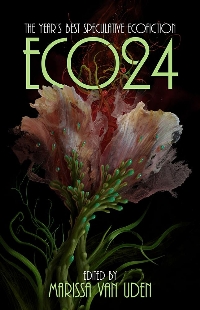
ECO24: The Year’s Best Speculative Ecofiction, edited by Marissa van Uden, does what it says on the cover, bringing together 23 high-quality short stories considering the future of the natural world, that came out within a set timeframe.
As with any anthology, I had favourites that will particularly stick with me and maybe even influence my own writing, and I was able to group many of the stories under broad subthemes, some of which I’ve appreciated in my previous reading.
The most effective stories, for me, came under the theme of social commentary on novel solutions to environmental decline. These stories ask: who bears the brunt of these innovations, and who gets to carry on as before?
The Plasticity of Being, by Renan Bernardo, is an especially striking example of this subtheme. A company has developed a solution to both plastic pollution and world hunger: an enzyme that enables people to digest plastic. As you might have guessed, though, the rich still get to enjoy their food. It’s fallen upon the residents of a Brazilian favela to literally eat rubbish, making for disturbing scenes.
Other stories on this theme that especially stood out to me were Bodies, by Cat McMahan, where the cloning of chickens has helped address food supply issues, but the cloned humans who work at the chicken plant are treated as second-class citizens, and Love, Scotland, by E.M. Faulds, where refugees find initial employment harvesting mushrooms that consume e-waste.
While the labours portrayed in Love, Scotland are arduous and physically risky, the story also has room for optimism and joy, bringing us to another subtheme that caught my attention: glimmers of hope at the end of the world (which I also enjoy across Katy Winhurst’s work).
My other favourite ECO24 stories in this vein were In the Field, by Shelly Jones, where a human researcher continues to send a droid out to interview people despite their repeated failure to find anyone to interview following a nuclear event, and The Last Library, by Joshua Jones Lofflin, where the two remaining staff members at a sinking library give away its books in order to preserve the knowledge it contained. Both of these stories are stark and sad, yet also portray humans refusing to completely give in to despair, adding an uplifting note.
Another welcome subtheme echoed in Katy Wimhurst’s stories, as well as some of those in Spread: Tales of Deadly Flora, edited by R.A. Clarke, is that of humans quite literally becoming one with nature. My imagination was particularly captured by Skittering Within, by Kelsea Yu, where a young girl grows up with an extraordinary affinity with crabs, and The Ghost Tenders of Chornobyl, by Nika Murphy, a stirring story where the titular spirits – not all of them killed at the time, or even by radiation – have the power to direct nature in a healing direction.
As in Love, Scotland, mushrooms are essential to the natural clean-up work in The Ghost Tenders of Chornobyl – and mushrooms are another subtheme I love to read about! They’re also used to brilliant effect in The Colonists, by Jennifer Hudak, where a grove of sentient mushrooms take action against the humans who plan to uproot them as part of their drive to colonise the mushrooms’ planet.
As these mushrooms are a collective, The Colonists also falls under my final subtheme: alien hive minds – an idea that first piqued my interest when I read The Space Between Us, by Doug Johnstone. Meanwhile, in the eerie and moving Swarm X1048…, by F.E. Choe, a throng of alien insects document the short life of a stray puppy born on a dying Earth, and love him despite their scientific brief to observe, inventory, archive, and not interfere.
ECO24 is a moving and thought-provoking collection featuring some of my favourite themes in speculative fiction.