Blog tour: The Princes of Pauper's Pond by Lars Elling, translated by Don Bartlett
This post is part of a blog tour organised by Random Things Blog Tours. I received a free copy of the book in return for an honest review.
‘1985. Nineteen-year-old Filip spends his days playing football, listening to music on his Walkman and drawing, searching for something he cannot yet name.
‘He lives in a large family house shared with his grandparents, where an old rift between his grandfather Arnstein and Arnstein’s brother Truls still governs the atmosphere. The cause appears trivial, an apple tree dropping fruit across a boundary fence, but the bitterness between the brothers speaks of something far older and deeper.
‘1912. With Europe on the brink of upheaval, Arnstein and Truls are sent into the forest for the summer by their stern father, determined that his sons should learn to endure hardship.
‘Left to fend for themselves among travellers, log drivers and Forest Finns, the brothers live from the land, fishing, hunting and roaming the vast woodland. Cold and hungry, yet bound together by fierce loyalty and affection, they crown themselves the Princes of Pauper’s Pond, rulers of a world defined by freedom, imagination and shared struggle.
‘Until, back home, their father makes a decision that will change everything.’
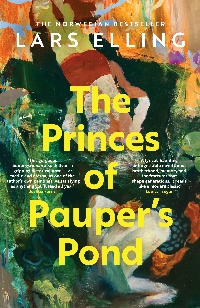
In The Princes of Pauper’s Pond, by Lars Elling, we follow two storylines. In 1985, Norwegian teenager Filip is at the point where he needs to decide what he’s going to do when he finishes school: art college is a possibility, but he’s yet to find his unique style. Every day, he sits with his co-resident grandfather Arnstein, who, coming to the end of his life, has decided to open up to Filip about his childhood and the real reason for his long-running feud with his brother Truls, who lives just next door in the other half of what was their childhood home.
In the early 1910s, young Filip and Truls are thick as thieves. On the command of their father – whom they semi-affectionately refer to as “The Kaiser” – they spend much of the long summer break in the vast forest not far from their home, sleeping in a tent, living off the land, and making their own entertainment. While the pair do have a few hair-raising experiences, it’s mostly a Boys’ Own-style adventure – until something goes horribly wrong, and life is never the same again.
I liked The Princes of Pauper’s Pond a lot, because it made me feel so many emotions. The main story about Arnstein and Truls’ childhood is brutal at times, and ultimately devastating, but there’s also a great deal of humour throughout the book that literally had me snorting out loud.
While the young pair don’t spend their summers in the forest of their own volition, they don’t particularly object to it, either. They relish the absence of adult supervision and prove themselves to be very resourceful when it comes to feeding, entertaining, and making a bit of money for themselves.
At the same time, this is far from a bucolic portrayal of the “good old days”: some of the things the boys do to wild animals certainly aren’t for the faint of heart; they’re not above stealing other people’s supplies; and there are some unsavoury characters also living in the forest that it’s best they stay clear of.
In fact, a key message I got from this book is that no person or situation is just one thing. The Kaiser is an absolute ruler in the family home – rounded out by the boys’ mother and older brother Tom Even (“Totem”), who has severe learning disabilities – but he also has an endearing enthusiasm for the natural world that he tries to impress on his children. The young Arnstein and Truls can be terrors, but they’re devoted to one another, and give heart-warmingly tender care to a cow they find in dire need of help. As an elderly man, Arnstein is by turns irascible and friendly towards Filip, who himself is alternately flippant and despairing.
As you might expect, the family relationships and dynamics in this novel were a major point of interest for me. In terms of sibling relationships, we’ve seen that Arnstein and Truls were exceptionally close as children, but set apart from Totem because his disabilities necessitated extra care and meant he had little in common with his brothers. In 1985, meanwhile, Filip’s older sister Turid has recently left home, and he’s adjusting to a new, more isolated and visible position in the household as a result.
When it comes to parent-child relationships, Filip’s father/Arnstein’s son – a psychiatrist – appears to have “done the work”/”broken the cycle” (not that it was referred to as such back then), as he’s a far gentler and more involved parent to Filip and Turid than The Kaiser was to his sons, or (we can gather) Arnstein was to him.
The focus on the men’s stories does leave their womenfolk somewhat reduced: The Kaiser’s wife has no choice but to go along with what he says; Arnstein’s and Truls’ wives are foot soldiers in the brothers’ ongoing war; and Filip habitually characterises his mother as a kind of domestic bird who can generally be found perched in one room or another, doing little of consequence.
At the same time, this is one of the many quirky observations Filip makes of the world around him that really amused me (though it was a little confusing that, every so often, his point of view would briefly switch from third to first person). More broadly, this novel isn’t only about Arnstein telling Filip a story, but the stories we tell ourselves: without giving too much away, the ultimate cause of the rift between the brothers is one of them inferring a particular message from The Kaiser’s treatment of them that might not have been intended at all.
The Princes of Pauper’s Pond is a highly moving and sophisticated novel.