Blog tour: Slow Burn by Amal Singh
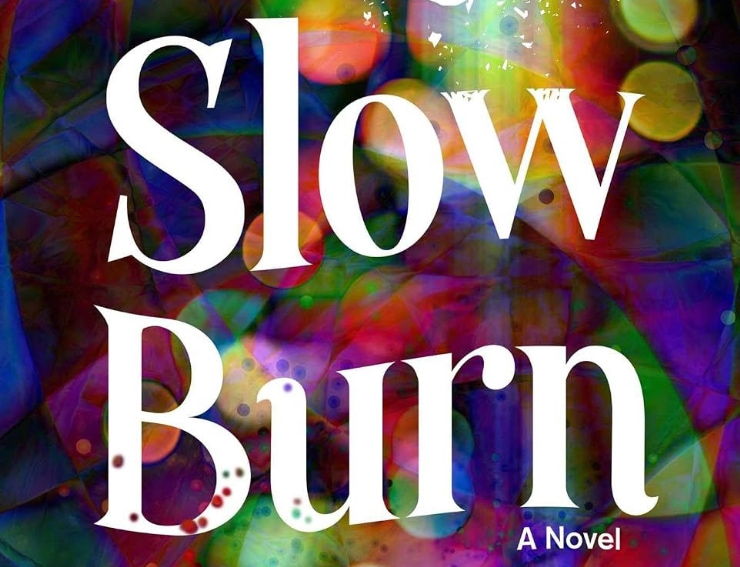
This post is part of a blog tour organised by Random Things Blog Tours. I received a free copy of the book in return for an honest review.
‘When Rishi Tripathi, a failed actor, falls through a mirror in an inverted Mumbai, he invites fame like he has never seen before. In this inverted city, he’s a superstar and a critically acclaimed darling.
‘But he soon realises that success bears a heavy cost. The cruel actions of his doppelgänger catch up to him, and he’s forced to find an entity called the Maker of Mirrors to return to his actual city.
‘But fame is also a drug, and Rishi has become an addict. Is he truly ready to return and embrace failure?’
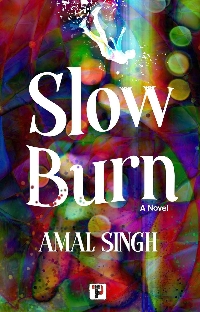
In Slow Burn, by Amal Singh, wannabe actor Rishi Tripathi punches a mirror after a spectacularly bad day – and falls through into an alternate Mumbai where another version of himself, going by the stage name of Rrish Kumar, is rich and famous beyond his wildest dreams.
However, as Rishi discovers when he slips into his doppelgänger’s life, Rrish is a reprehensible character who has treated people awfully both on and off set. Rishi attempts to reform Rrish’s character at first, but his pure intentions go astray as he gets a taste for fame and power, and realises there’s only so much he can do to redeem his depraved counterpart.
Meanwhile, Rrish is rather enjoying his sojourn into Rishi’s small, simple life, and is in no hurry to reassume his old one. How can Rishi get home? And what will happen if Rrish refuses to swap back?
I found a lot to enjoy in Slow Burn! It blends three elements I really like – life-swapping, portals, and mirror magic – and takes some interesting twists and turns.
The swap of Rishi and Rrish drove the plot and kept me hooked. As with any story of this kind (think: The Parent Trap; Daphne du Maurier’s The Scapegoat), I was raring to see how Rishi would fare when thrown into Rrish’s life. Would he manage to improvise quickly and effectively enough that those around him (both totally new and variations on people from his own world) wouldn’t notice anything different about him?
Like the impostor in The Scapegoat, Rishi sets out to right the wrongs of the man he’s standing in for; unlike du Maurier’s creation, though, he diverges from this path, coming to act in ways more characteristic of Rrish than the old Rishi. This raises the question of whether Rishi was actually that nice, deep down, to begin with: if he’d been fortunate enough to find fame in his home world, would he have become as corrupt as Rrish? Or was it being ruthless from the outset that gave Rrish the edge Rishi lacks?
The portal aspect captured my imagination too. It was fascinating to see how people, places, and even the Indian film scene as a whole differed across the two Mumbais. The presence of a small number of other interdimensional travellers adds a frisson of eerieness and intrigue to proceedings – and it makes total sense that one of them is a cat!
There is a death that occurs in both universes, which prompted me to wonder how tied-together they were: was it just a coincidence? Or if someone dies at a certain time in one universe, do all their parallel selves die in some way or another at the same time? I also wondered how “real” Rishi and Rrish perceived their new homes to be: did Rishi’s actions in particular feel less consequential than they would have if he’d done them in his home world?
The book is let down slightly by a couple of continuity errors (a character who was with his girlfriend just the previous night goes on a Tinder date; another character’s name changes for a chapter) – I’m pretty sure they weren’t intentional fragments of dimension-switching weirdness anyway, as there’s no subsequent explanation.
The mirror magic element was a real highlight for me: I loved the interlude that tells the story of how the mirrors connecting the two Mumbais came to be, and thought it was a shame it was so far into the book, and more wasn’t made of it, as it was so imaginative. Theoretically, the mirrors could create/open up infinite parallel worlds, and while the short novel format necessitates a focus on just one person’s story, it might have been nice to get more of a taste of these possibilities beyond the dimension Rishi refers to as “Mumbai-Right”.
Slow Burn is an imaginative and enjoyable parallel universe fantasy.