Review: The Map of Lost Places, edited by Sheree Renée Thomas and Lesley Conner
I received a free copy of this book from the publisher in return for an honest review.
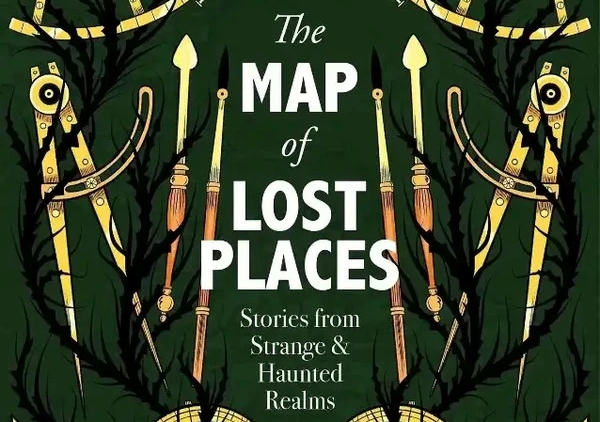
‘A travel guide to hauntings and the haunted, to lands with their own power, and to the communities that spring from these strange realms.
‘From arcades along a boardwalk and jetties at the edges of tourist towns, to a rural village in Pakistan and hollows hidden deep within a forest in Pennsylvania, strange things can happen no matter where you are. You can become lost in a city crowded with people, haunted within your own home, and slip from one reality into another in the space of a step.
‘With 22 stories by authors such as Brian Keene, Maurice Broaddus, Ai Jiang, Samit Basu, and KS Walker, editors Sheree Renée Thomas and Lesley Conner take readers on a tour of places where weird things happen. Places where ghosts are real, old gods are hungry, and towns are not as idyllic as they appear to be.
‘Welcome to The Map of Lost Places. Enter at your own risk.’
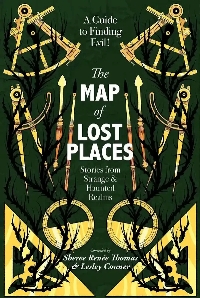
Packed as it is with 22 stories set in different times and locations, but with the shared theme of strange happenings tied to particular places, The Map of Lost Places, edited by Sheree Renée Thomas and Lesley Conner, has something for everyone. As with all anthologies, there were some stories that really stood out to me and others that left me cold, and I’ve grouped my favourites together under loose themes.
The stories that grabbed me the most were the ones that pushed the boundaries of the brief and form, and had a dream-like feel – reflecting some reading/writing interests I’ve had recently.
Codewalker, by G. M. Panniccia, starts in the virtual environments of an obsolete virtual reality system, but ends with the main character stuck in the simulation, unable to distinguish what’s real and what isn’t. Development/Hell, by Samit Basu, tells the intriguing backstories of a monster as they shift and adjust to new forms and habitats, contemplate their purpose, and try to come to terms with the lack of agency and meaning across their lives.
Place of Lost Stories, by Rich Larson, is similarly kaleidoscopic. The first time I read it, I wasn’t sure if I’d “got” what was going on, but a second reading shored it up for me, and I suspect subsequent re-readings would reward me further still. My current understanding is that it follows a depressed, functioning alcoholic writer on an hours-long roadtrip through wasteland (which might or might not be post-apocalyptic) to visit his grandmother, during which he bounces abortive story ideas off an unusual companion.
Three other stories I particularly enjoyed had fairytale/folklore vibes. In both Hulderhola, by Oliver Ferrie, and Silverheels, by Rebecca E. Treasure (set in Norway and Colorado respectively) the fabled entity haunting the mountains saves a woman from a predatory man – you love to see it. Meanwhile, in the similarly scenic and eerie In Nobody’s Debt, by Jenny Rowe, a magical singing lake in Sweden colludes with local women to lure unsuspecting men to their deaths.
I also especially liked Girlboss in Wonderworld, USA, by Vivian Chou, and Chuckle Wet, Chuckle Low, by R. L. Meza, which have shabby seaside settings in common – something else that interests me, as I lived in such a place for a few years growing up, and I’ve long felt like I should be able to get some sort of story out of it.
Girlboss centres around a typical amusement arcade, where an eternally-youthful employee grants a repeat customer an aspirational middle-class life in exchange for bodily qualities and parts that might not be too sorely missed in isolation, but eventually mount up. In Chuckle, a group of drug addicts living in a camp near a beach sacrifice innocent tourists to the jetty in return for valuable hauls of treasures left behind by affluent beachgoers, an arrangement that works well for both sides – until it doesn’t. Both stories are satisfyingly creepy.
In fact, “satisfyingly creepy” is how I’d describe a couple of other stories that stood out to me: All Praise the Durians by Joshua Lim, where the titular fruit are cultivated in unusual ways by non-human entities, and Salt, by K.S. Walter, which features a scary house and a friendly ghost. I additionally really liked Inviting the Hollow Bones, by Octavia Cade, for its terminally-ill protagonists’ discussion about the purpose and preservation of legends, and its shock ending.
The Map of Lost Places is a compelling collection of unsettling stories set around the world – and beyond.