Review: Nameless by Zoe Ann Wendler

I received a free copy of this book from the author in return for an honest review.
‘It was supposed to be a nothing job.
‘Identify a body that’d been reduced to its component elements by a swarm of nanites, get a paycheck. Satya Hassan didn’t have to like the cops to like paying rent, and when unemployment is over 60%, well, a gig is a gig.
‘Only now, she and Dan Landvik, a detective just promoted to homicide, are trapped between amoral megacorps, an uncaring government, and a mass-murderer that the Minneapolis Police Department doesn’t dare to touch.
‘Betrayed again and again by the people they thought they could rely on, facing an enemy they can’t pin down, and without even the name of a victim to go on, Dan and Satya will have to do more than uncover a conspiracy – they’ll have to face their own lifetimes of queer trauma, make allies out of enemies, and maybe even change the world along the way.
‘Or, at least, save a small cat with a prosthetic leg.’
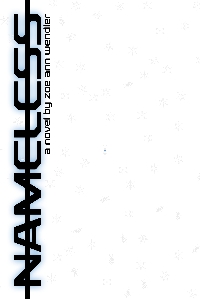
Nameless, by Zoe Ann Wendler, is set a handful of years from now. Nanite technology has revolutionised manufacturing: with a blueprint, materials, and a suitably-sized “maker”, anybody can make anything, from food to fully-functional prosthetic limbs. As nanites can break down waste to produce these materials, the planet is getting cleaner and climate change is going in the right direction.
Unfortunately, the worst aspects of capitalism persist. People are still expected to work for subsistence, even though there are many fewer jobs now that most things can be made at home. The gap between the rich and the poor has grown even larger, and the police only care about protecting the former. Nanites can make – and be used as – weapons, and the US’s refusal to grant China access to its innovations resulted in a devastating war.
When idealistic cop Danica (Dan) Landvik goes to freelance programmer and traumatised veteran Satya Hassan for help identifying a murder victim whose body has been degraded by nanites, things escalate quickly. The nanites involved are a revolutionary new model nobody’s seen before – and there are dangerous people out there who will go to extreme lengths to keep things that way.
I found Nameless a great read! As well as being fast-paced with some real heart-in-your-mouth moments, the author has really thought through the capabilities and limitations of the novel technology she introduces, as well as its consequences for all aspects of society and around the world.
Satya and Dan are well-realised, compelling characters, and I loved watching them become firm friends after their awkward initial encounter. Their need to get to know and trust each other pretty fast means the reader also gets to learn about them in an unforced way that avoids exposition, and there are some brilliant flashes of humour in their interactions to boot. And, of course, I adored Muezza – Satya’s little grey cat who, like his owner, has a sophisticated prosthetic limb.
At the same time, Wendler isn’t afraid to put her lovingly-crafted characters into life-or-death situations. Satya in particular goes through some horrendous things, both in her present situation and in flashbacks from her past, giving me lots of big feelings.
As you might have guessed, nanites were absolutely used in the war to lay waste to people – Satya being one who lived to continually repeat the experience in her mind – and the military is especially keen to take advantage of the latest innovations as they develop, waving away the ethical questions that arise.
The future presented in Nameless isn’t all doom and gloom, however. Two notable themes are gender/sexuality and disability. While Satya and Dan have experienced instances of transphobia and homophobia respectively, the general trend appears to be towards more acceptance and understanding than we have today (plus, I came away from this book with a clearer idea of what dysphoria is, and how it feels).
The advent of nanites and makers, meanwhile, seems to have shifted the general idea of assistive devices away from “things that restrict people” to “things that enable and even empower people”, and it feels like there’s more of an emphasis on choice, too.
For example, one secondary character (and ally against the baddies) has opted to upload himself into a computer monitor with robotic arms and legs rather than continue to live in a deteriorating body, and is entirely happy with this decision. Meanwhile, Satya is pleased with her prosthetic arm, “meh” about her prosthetic leg, and unable to come to terms with losing one of the breasts that made her feel right for the first time in her life.
Nameless is an exciting, nail-biting and well thought-through sci-fi thriller.