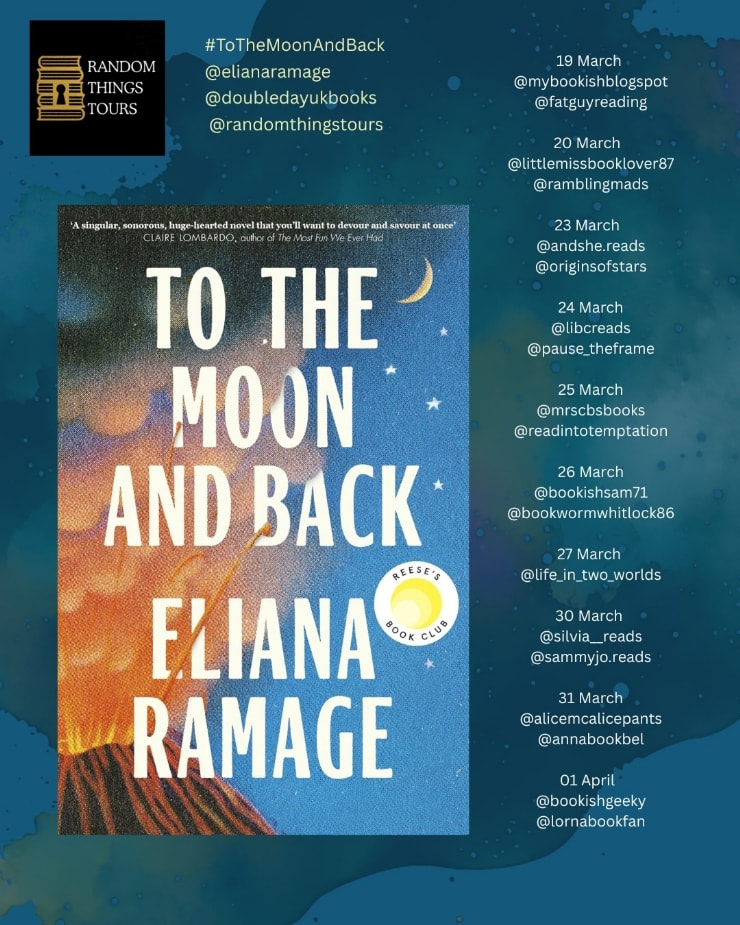
Blog tour: To The Moon and Back by Eliana Ramage
This post is part of a blog tour organised by Random Things Blog Tours. I received a free copy of the book in return for an honest review.
‘When she was five, her mother ran – with Steph and her younger sister in tow – from an abusive husband into the arms of a small Cherokee community, where she hoped they might finally belong.
‘But Steph soon sets her sights as far away as she can get, vowing that she will let nothing interfere with her dream to become an astronaut, and ultimately, to go to the moon.
‘In Steph’s certainty that only her ambition can save her, she will stretch her bonds with the three women who know and love her most dearly: her younger sister Kayla, an artist whose determination to appear good takes her life to unexpected places; her college girlfriend Della, who strives to reclaim her identity as an adult after being removed from her family as a young girl through a challenge to the Indian Child Welfare Act; and her mother Hannah, who has held up her family’s history as a beacon of inspiration to her kids, all the while keeping the truth about her own past a secret.
‘Told through these women’s interwoven lives, and spanning three decades and several continents, To the Moon and Back is an astounding and expansive coming-of-age novel of mothers and daughters, love and sacrifice, alienation and heartbreak, terror and wonder. At its core, it is the story of the extraordinary lengths one woman will go to find a little space for herself.’

To The Moon and Back, by Eliana Ramage, follows aspiring astronaut Steph Harper from the age of five, when she, her mother Hannah, and baby sister Kayla escape from her temperamental father in Texas and settle into the Cherokee County city of Tahlequah, to her mid-30s, when she’s an astronaut candidate (aka an ascan) and closer than ever to realising her dream.
Along the way, Steph struggles against her family’s lack of affluence, and Hannah and Kayla’s preoccupation with their ancestral past, as opposed to the potential future beyond Earth that so fascinates her. She discovers she’s attracted to women, and has a series of relationships that end disastrously. But she eventually comes to learn a thing or two about life on Earth, finding a modicum of stability and peace.
I found so much to love in To The Moon and Back! As well as having a highly compelling story and characters, I was really into the details about space and astronaut training, and Cherokee history and culture, and found the novel’s themes very thought-provoking.
Steph is often frustrating and enigmatic to Hannah, Kayla, and other characters she forms relationships with throughout the book, but I felt sympathetic towards her – probably because, to my mind at least, she’s autistic.
She’s obsessed with space and can reel off facts about it for hours; she’s prone to bluntness and social faux pas; she’s not exactly flexible; and her communication skills aren’t the best. For example, she ends relationships with actions rather than words, for reasons that are logical to the reader who has an insight into her thought process, but opaque and upsetting for the recipient.
The standout theme of the story for me was heritage, and how people interact with and honour it. For Hannah and Kayla, it’s integral to their lives: the former is an active member of the Cherokee community she’s chosen to live in, while the latter embraces her inherited culture and fights for indigenous causes (even ones that aren’t hers, leading to accusations that she’s drawing attention to herself as an online personality instead of amplifying others’ voices).
Steph’s mother and sister frequently express disappointment that she’s not as attached to Tahlequah or into Cherokee culture as they are, which felt unfair to me because a) it’s up to her how extensively she wants to engage with her heritage, and b) as Steph and the author point out, if she makes it to the moon, that will become part of their history, as a living thing that’s continually unfolding.
This notion that history is never set in stone or “finished” comes out in other ways. One is that the three women are forced to reckon with the actions of ancestors who weren’t the “perfect victims” of colonisation – for example, selling their land to settlers out of greed, colluding with the enemy for personal gain, or falling in with their oppressors in terms of what to teach Native American children, and how to teach it.
These are hard truths that I hadn’t been aware of before, and I was pleased that the characters confronted them. For one thing, representing all victims of colonialism (or any historical wrong, for that matter) as innocent saints flattens out any in-group diversity or deviation and detracts from their humanity, making them less like “real people” worth taking a closer look at and finding ways to relate to.
For another, finding out more about particular individuals or sub-groups, and re-evaluating figures who have previously been portrayed as unproblematic – not unlike tearing down a contentious statue, or being the first Native American on the moon – adds to the story and keeps history alive.
The question of how we represent history, and to what ends, also comes out in a chapter where teenage Steph is working as a reenactor at a living museum of traditional Cherokee life. When Steph is left in charge one afternoon, she and the other employees ham it up to entertain a young boy who’s fixated on the barbaric practices popularly associated with Native Americans – to the chagrin of their manager, who wants the museum to challenge this narrative, rather than perpetuate it, even if the latter does result in more satisfied visitors.
To The Moon and Back additionally explores a theme that never fails to capture my attention: siblings, specifically the relationships between them and the way they don’t necessarily have the same environment and experiences growing up, despite sharing one or both parents and a home. Steph and Kayla’s respective ages at the time they fled to Tahlequah divides them: Steph remembers their father, living in Texas, and the manner of their leaving, while Kayla has only ever known their Cherokee life, and fully accepts it.
This notion of belonging through full immersion in a particular community also surfaces in the narrative of Steph’s college girlfriend, Della. Born to a white woman who didn’t want her and a Cherokee man who did, and raised by a white Mormon couple, as a child Della was the subject of a highly-publicised custody battle, which her adoptive parents won in spite of the Indian Child Welfare Act, which aimed to keep Native American children with their families and tribes.
Consequently, Della only saw her Cherokee family once a year when she was growing up, and arrives at college feeling “neither here nor there” about her identity, but keen to explore her Cherokee side, even if that means getting it wrong sometimes, and not being fully in step with her and Steph’s Native American friendship group. On top of this, Della’s adoptive parents are far from happy when she comes out as a lesbian, triggering her abandonment wounds and making her feel even more adrift.
To The Moon and Back is a propulsive and engaging novel that contains multitudes.