Blog tour: The Wrong Son by Neil Griffiths
This post is part of a blog tour organised by Random Things Blog Tours. I received a free copy of the book in return for an honest review.
‘In 1963, a young husband loses his pregnant wife and eighteen-month-old son in a car accident. Six months later, he meets a woman who abandons her own husband and child for him – a man who seems to her everything she has ever wanted.
‘Within two years, a boy is born into this family of grief and guilt: into a house already filled with ghosts, where neither parent can see him clearly through what each has lost. His mother demands perfection. His father, meanwhile, decides early on that this child exists only because the first one died – and cannot forgive him for it.
‘Moulded by his mother, rejected by his father, he is given no space in which to become himself. Throughout his life, no matter how much he tries to invent himself, he is driven by the fear that nothing real exists underneath.
‘Fifty years on, after his parents’ deaths, that fear begins to unmoor him. He turns to the work of psychoanalysts who were pioneers of early childhood psychology around the time he was born. Drawing on the insights of D.W. Winnicott and Jacques Lacan, The Wrong Son traces a life shaped not only by loss and violence, but by psychic damage that may never fully be shaken off.’
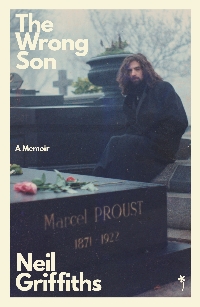
In The Wrong Son, writer and publisher Neil Griffiths presents his life story, including the tragic circumstances that shaped the atmosphere he grew up in, which has continued to affect him mentally and emotionally.
In 1963, Griffiths’ police officer father lost his first wife and toddler son in a terrible car accident. In keeping with the time, it wasn’t long before he remarried, but when Griffiths was born, his father couldn’t bring himself to love him – because this second son wouldn’t exist without the death of the first, and he would always compare the younger child to the older, rendered perfect by his untimely death. What’s more, Griffiths’ mother had left a husband and young daughter – whom she wasn’t allowed to see as a result – to devote herself to his charismatic father.
Knowing nothing of his parents’ histories until he was 12, Griffiths was treated coldly and sometimes violently by his father, while his mother was primarily concerned with keeping him quiet and well-behaved as part of her constant drive to manage his father’s moods.
Outside of the house, Griffiths cultivated a bullish, reckless persona, rebelling against everything his parents wanted him to be. However, he actually felt adrift, and like he didn’t really know who he was. His relationship with his father deteriorated even further as he grew older and became less willing or able to hide this other side of himself.
While Griffiths eventually matured and built a stable life with a family of his own, the death of his father when he was in his early 50s forced him to reckon afresh with the feeling of emptiness he’d always carried within.
The Wrong Son is one of the most thoughtful, and thought-provoking autobiographies I’ve read – and I’ve read a lot of them (yes, I am going to refer to my PhD research a bit in this post!).
I went in with my usual awareness that any memoir is just one person’s truth, based on their most significant memories – the recalling and interpretations of which change over time, but nonetheless show what the author finds important and attaches meaning to – and necessarily includes scenes they’ve imagined, because they took place before they were born.
That said, Griffiths describes such scenes so vividly, you almost forget he wasn’t actually there. He doesn’t gloss over or dismiss other people’s highly contrasting experiences of his father, or his own faults or bad behaviour, especially during his turbulent teens and 20s, which I found admirable. He’s also strikingly magnanimous about his parents wanting, and having a child of their own, as that was just what youngish people in new marriages did at that time, and nobody expected any different.
As with the events that precipitated his birth, Griffiths reconstructs scenes from his childhood with such skill, I could absolutely picture them in my head. At the same time, his writing is remarkably unembellished, and this stark style actually increases the impact of the stories he’s telling, as his father’s harsh words and actions demonstrably don’t need extra dressing or picking-over to shock you.
In a similar vein, rather than gratuitously itemising every wrong his parents committed against him, Griffiths presents a series of key incidents between more quotidian (but nonetheless really interesting) passages about school life and how he spent time with his friends growing up. This, along with the dark humour woven throughout, means this book is far from a “misery memoir” – I certainly found it a lot more entertaining than I was expecting!
What’s also interesting is how Griffiths has sought to understand and explain his experiences with references to thinkers such as D.W. Winnicott and Jacques Lacan, as well as society’s expectations of men and women, and attitudes towards grief, mental health, and divorce around the time he was born in the 1960s. (I’d have also thrown John Bowlby’s attachment theory into the mix!)
As I was reading, my mind kept pinging with recognition of discoveries and conclusions from my own work: chiefly that so much of whether you have a “happy” childhood hinges on how your parents came to have children (did they truly want them, or were they just following expectations? Had they lost previous pregnancies/children?), their attitudes towards children (as Griffiths mentions, his father especially was out-of-step with contemporary childrearing fashions, retaining the old authoritarian, “seen but not heard” attitude), and the atmosphere in the home.
While, unlike the main people whose life stories I studied for my thesis, Griffiths was not an only child, the more positive childhood experiences of his younger sister – whom their father may have found easier to love on account of her gender – demonstrate how siblings may share parents and a home, but not necessarily an environment. Nor did having a sibling help Griffiths feel less psychically alone, as the two of them had their own lives and interests; for a period in their teens, he admits, there was even some violence in their relationship.
All this rationalisation can only get us so far, though: Griffiths suffered for decades and didn’t really start to heal until his 50s, when his father died and he finally found the right kind of therapist. The main feeling I came away with (that Griffiths shares, even if he could forgive his parents for having him at all) was outrage at the baggage his parents put onto a helpless, innocent baby without stopping to consider how it might damage him.
There’s so much on social media today about “doing the work” to “break the cycle” (i.e. consciously committing not to repeat your parents’ mistakes and/or pass on inherited trauma to the next generation), yet it wasn’t so long ago that most people simply didn’t think about how their particular issues might affect any children they had. Saying that, though, Griffiths discusses his worries that he’d be a bad parent when his own children were born in the early 2000s because he didn’t have a mental model of a good father to aspire to, as well as sometimes catching himself acting like his father and trying to correct his course – so he was already doing those things, but without the terminology that’s emerged in more recent years.
The Wrong Son is a striking, thoughtful, and self-aware memoir.