Blog tour: The Maternal Element by Kate Nicholls
This post is part of a blog tour organised by Random Things Blog Tours. I received a free copy of the book in return for an honest review.
‘Siberia, 1833. Forty-one-year-old Maria Mendeleeva is enduring her seventeenth pregnancy. With her husband losing his sight and her family’s glass factory in ruins, Maria stands on the brink of poverty. To survive, she must reclaim her grandfather’s legacy, defying the strictures of her time to make the glass sing once more.’
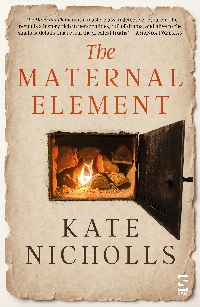
The Maternal Element, by Kate Nicholls, follows the waxing and waning fortunes of Maria Mendeleeva (née Kornilyeva) from 1899, when she’s an inquisitive six-year-old living with her middle-class family in Tobolsk, Siberia, to her death in reduced circumstances in St Petersburg in 1850.
Over the course of her life, Maria bears 17 children – nine of whom survive childbirth/infancy, with three of the survivors dying in their teens or twenties – spends some years managing the Kornilyev glass factory after her teacher husband Ivan loses his sight, and places a high value on education, while lamenting Russia’s lack of schooling provision for girls. Towards the end of her life, she goes all-out to secure a university place for her last child, Dmitri – who later gains recognition for devising the Periodic Table, among other scientific achievements.
I found The Maternal Element a really absorbing read! By giving close attention to this resouceful and determined nineteenth-century Russian woman and her family, the author renders the ordinary extraordinary, and creates a full cast of distinct characters I quickly grew attached to and wanted to keep following. In times of fortune, the Mendeleev household feels cosy and full of good cheer; in times of strife, I felt devastated for the characters, yet also warmed by the ways they cared for one another.
Nicholls portrays Maria as resolute, resilient, and a loving parent, without rendering her unrealistically perfect or universally admired. For example, there are periods when Maria is emotionally unavailable to her children due to grief, or practically unavailable because she needs to be on site at the factory (both understandable, though not ideal). Furthermore, Maria’s stridency does alienate some people, including her brother Vasily, and prevents her from recognising how deeply her son Vanechka suffers when he’s sent to an elite boarding school in Moscow (paid for by Vasily).
Despite their number, we get to know the personalities and interests of each of Maria’s nine surviving children, and I felt a real loss when, at disparate points, three of them died of causes that we can now vaccinate against and/or treat more effectively. I also built up detailed pictures of Maria’s likeable husband Ivan; the idiosyncratic “Nyanya” who helps bring Maria up after her mother dies in childbirth, and goes on to help Maria raise her first few children; and Peter Grigorievich, groundsman to the Kornilyevs and (later) the Mendeleevs. Additionally, there are lots of supporting characters who make lasting impressions through short but memorable descriptions.
With my “historian of childhood and the family” hat on, it was really interesting to see the various family dynamics that arose from birth order, gender ratios, age gaps, and employment/financial circumstances at different times. I found the playful bond between Mashenka, Ekaterina, and Olga – Maria’s first three children to survive childbirth/infancy – especially endearing, easily grouped together as they are by age and gender.
Similar groupings emerge among the later arrivals, and while a couple of the siblings seem somewhat set apart from the others by their experiences (Vanechka’s boarding school ordeal) or peculiarities (Appolinaria’s asceticism), nobody is overlooked, excluded, or unloved. When the family lives in Tobolsk, the tumbledown apple store at the back of the house proves a useful place for some or all of the children to confer, away from the watchful eyes of their caregivers.
That’s not to say all of Maria’s children had fundamentally similar childhoods, though. The older siblings have memories of houses and people the younger ones don’t (Nyanya and a beloved sister who died in her teens being prime examples), and everyone’s early experiences of their parents vary depending on how stressed Maria and/or Ivan were at particular times by bereavement, ill health, financial circumstances, moving house, and the political climate as determined by the Czar (this sometimes having a bearing on Ivan’s job as a teacher, and the need to relocate).
Furthermore, some of the children grow up living with more of their siblings, and for a longer time, than others, as the older ones leave home to get married or learn a trade. By the time the widowed Maria settles in St Petersburg, only Elizaveta and Dmitri (by then in their mid-teens and mid-twenties respectively, and born either side of Vanechka, Detochka, and Pavel) are still living with her, in rented rooms. This is where she succumbs to tuberculosis: a rather small-feeling death for a woman who at one time simultaneously helmed a successful glass factory and a lively young family.
The Maternal Element is an absorbing and moving historical novel that will stay with me.