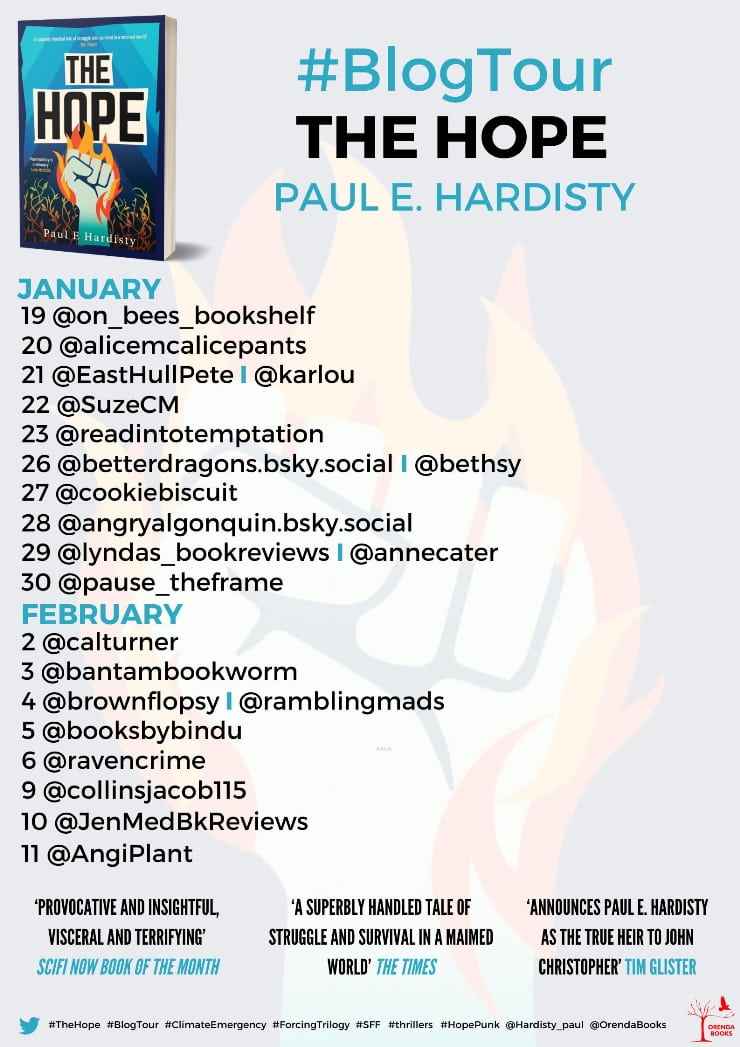
Blog tour: The Hope by Paul E. Hardisty
This post is part of a blog tour organised by Random Things Blog Tours. I received a free copy of the book in return for an honest review.
‘The year is 2082. Climate collapse, famine and war have left the world in ruins. In the shadow of the Alpha-Omega regime – descendants of the super-rich architects of disaster – sixteen-year-old Boo Ashworth and her uncle risk everything to save what’s left of human knowledge, hiding the last surviving books in a secret library beneath the streets of Hobart.
‘But Boo has a secret of her own: an astonishing ability to memorise entire texts with perfect recall. When the library is discovered and destroyed, she’s forced to flee – armed with nothing but the stories she carries in her mind, and a growing understanding of her family’s true past.
‘Hunted and alone, and with the help of some unlikely allies, she must fight to save her loved ones – and bring hope to a broken world.’
In The Hope, by Paul E. Hardisty, it’s 2082 and we follow teenager Becky (Boo) Ashworth from her burning home to an oligarch’s palace, where she’s forcibly inducted into his harem – but secretly conspires to help overthrow this wealthy family who terrorise and impoverish her corner of Tasmania.
Along the way, we learn how Earth got into a state where habitable areas and populations of humans and animals have severely declined, resources are scarce unless you’re one of the super-rich, and books are forbidden, lest anyone get dangerous ideas about how a better world is possible.
This information is conveyed to us via Boo’s perfect recall of a book written by her Uncle Kweku: while her family’s secret library has been destroyed by armed insurgents, and this particular volume is no longer in her possession, their contents are not lost – so long as Boo survives and escapes the palace, that is.
Starting this review with a quick confession: I didn’t realise The Hope was a follow-up to The Forcing and The Descent – neither of which I’ve read – when I put myself forward for the blog tour. However, as this book foregrounds different characters over a decade on from the events of The Descent, and Kweku’s book explains so much of the context, I didn’t feel particularly disadvantaged in this respect.
In fact, I was drawn into the story very quickly, beginning as it does with a life-threatening situation and Boo becoming separated from the other members of her household as she flees for short-lived shelter in the mountains. From there, she lurches from one nail-biting crisis to the next, finding out first-hand how brutally and unforgivingly those in the service of Eminence Valliant Junior are treated.
What’s more, the political developments and consequences that led to collapse for all but the wealthiest feel all too possible, especially considering the news over the last couple of weeks or so. This makes The Hope very compelling: what it describes is horrible, but you can’t look away, and all the time you’re thinking ‘could this please not happen in real life?’
The thing I liked most about The Hope, though, is its reverence for, and use of books, literacy, and stories. As hinted above, more than one political regime in this series has purposely cut people off from even learning to read, and therefore diminished their exposure to opposing viewpoints, and capacity for critical thinking.
Due to her family’s efforts to preserve whatever books they can find, as well as document their own stories (in-universe, The Forcing and The Descent were written by Boo’s grandfather and Uncle Kweku respectively), Boo is unusually literate for her time. While she does admire and respect books as physical objects, her appreciation for their contents rightly reigns supreme.
Not only does Boo’s extraordinary memory ensure that words outlast the destruction of the paper they’re printed on, but she also truly engages with what she’s memorised. As well as using stories to escape her harsh existence, understand the world around her, and see things through other people’s eyes, she habitually refers to authors and books, and puts some stories she knows to clever use inside the palace. I also enjoyed the tongue-in-cheek reference to another book by Hardisty, and the shout-out to publisher Orenda.
There were, however, a couple of things that niggled at me. One was that the author falls into the odd “men writing women” trap, with Boo’s thoughts and observations occasionally not quite ringing true, and some instances of female nudity/sexuality that felt more like they were catering to the straight male gaze than advancing the plot.
I also felt a bit uneasy about the two principal “baddies” being disabled – not because you shouldn’t have disabled villains (you totally should! Representation beyond “resilient”, “brave”, and “inspiring” matters!), but because of the way the author repeatedly refers to their disabilities, connecting them with their respective undesirable personalities and rendering them grotesque.
The Hope is a scarily plausible post-apocalyptic thriller and love letter to books and reading.