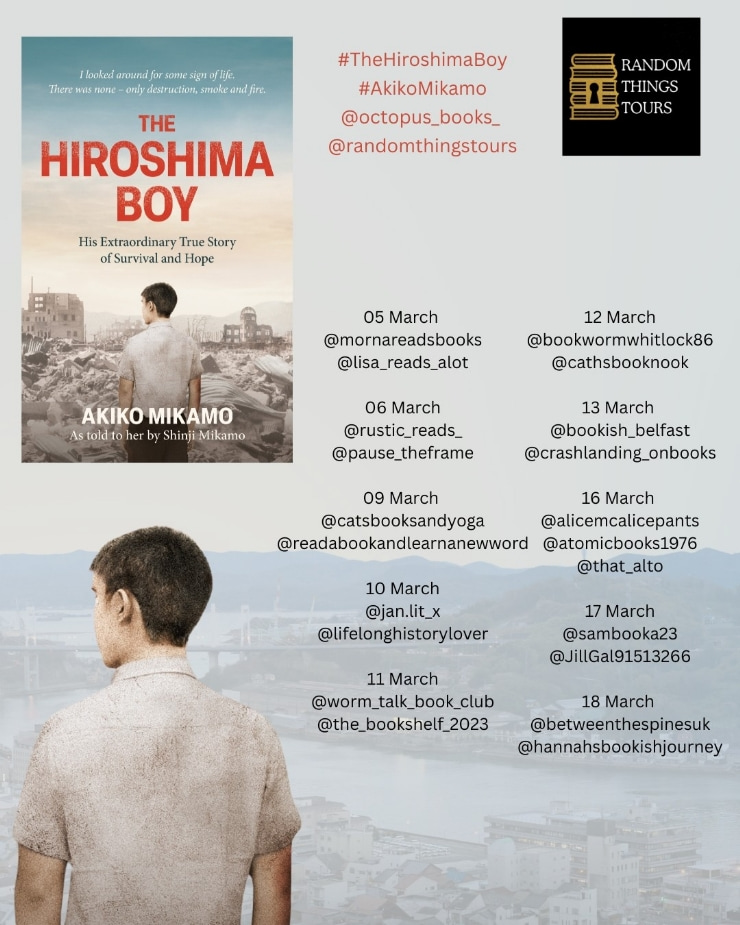
Blog tour: The Hiroshima Boy by Akiko Mikamo, as told to her by Shinji Mikamo
This post is part of a blog tour organised by Random Things Blog Tours. I received a free copy of the book in return for an honest review.
‘As the soldiers lifted me from the floor, my father’s eyes locked with my own. For just a moment, I thought I saw a shadow of sadness across his face. But it disappeared as quickly as it had arrived, replaced with my father’s look of perpetual determination. “You’ll find me at the hospital,” I said to him. He made no response to this. “Be well, Shinji,” he replied to me.
‘Shinji Mikamo, a teenager, is on the roof of his house, working with his father, when there is a blinding flash. When he regains consciousness, he is severely injured, burned all over his body, and buried in the rubble of a building.
‘Somehow, his father manages to pull him out, and together they begin to search for help. They were – it turned out – only 1200 metres away from the centre of the explosion.
‘The Hiroshima Boy tells the story of Shinji and his father’s journey through Hiroshima as they come face to face with the utter destruction of the city and meet neighbours, friends and strangers enduring unimaginable agony.
‘Running from an enormous fire engulfing their neighbourhood, they reach the banks of the Kyobashi River. But the water provides little comfort, and the scenes they find there are devastating. For the next four days, they roam, searching for food, water and refuge in excruciating pain.
‘Eventually, they reach a village outside Hiroshima City, where Shinji is able to be transferred to a hospital. But to do so he must leave his father, not knowing whether he will ever see him again…’
The Hiroshima Boy is the life story of Shinji Mikamo, who was a 19-year-old electrical technician for the Japanese Army when the US dropped the atomic bomb on his city on 6 August 1945.
Shinji suffered extensive burns, and it was days before he was able to obtain proper medical help. In the meantime, he and his father – his only close relative still in Hiroshima prior to the explosion – walked around the city seeking aid, witnessing hellish scenes and both the best and worst of humanity. When Shinji was finally moved to a hospital, he was separated from his father, with no way of finding or contacting him.
Once he was well enough to leave hospital, Shinji faced multiple challenges: tracking down any family he might still have left, finding somewhere to live, and obtaining a new job. Over time, he was able to build a new life for himself, but what he saw and experienced as a teenager both scarred him and imbued him with lifelong beliefs in forgiveness and peace.
Shinji Mikamo’s account of Hiroshima – authored by his daughter, Akiko – takes a very different approach to The Children of Hiroshima, by Sadako Teiko Okuda, which I read last year. While the latter focusses almost exclusively on the horrific scenes the author witnessed in the wake of the bombing, The Hiroshima Boy takes a bigger-picture approach, situating the blast as an event with a “before” and an “after” for both Shinji and his city – something I especially valued.
That’s not to say that The Hiroshima Boy doesn’t contain its share of shocking, harrowing scenes, though. Shinji himself suffered life-threatening burns and unimaginable pain, and by necessity describes the carnage he encountered as he and his father moved from place to place seeking aid, as well as the appearance of his worsening wounds and the medical procedures he endured. While the focus is not exclusively on the days that the horror was at its height, the message remains clear: the bombing was a morally reprehensible, inhumane action, and nuclear weapons should never be used again.
From the start of the book, we get to know not only Shinji, but also his family and friends, and learn about his living and work situation, different parts of Hiroshima, and what it was like to live there, and in Japan more generally, in 1945.
As well as finding this all really interesting (I do love reading about people’s families), I alternately felt touched by Shinji’s sadder memories and entertained by his happier ones, particularly when his father’s legendary dry, irreverent wit made an appearance! For example, the irony wasn’t lost on either of them that the explosion destroyed their house just as they were in the process of dismantling it themselves, following ill-thought-through government orders aimed at preventing the spread of fires in the event of more conventional bombing.
Prior to the blast, and even more so in the days and weeks following it, Shinji’s father is central to his life and story, as it was just the two of them: Shinji’s mother had gone to live with his aunt in the country on account of advanced illness, and his older brother was away fighting in the Philippines.
Like a number of the people Sadako Teiko Okuda meets in The Children of Hiroshima, Shinji’s father pushed through his own injuries and devoted the last of his strength to trying to get help for his son, and not letting him give up. In hospital, all Shinji could think about is his father, and his father’s pocket watch – which Shinji later recovered from the wreckage of their home, its hands blown off and the time of 8:15 burned into its face – became an important object for him.
Many years later, though, the watch was stolen from an exhibition in New York City, and this is just one example of the less good side of humanity Shinji portrays in this book. Another, especially egregious instance is when a pair of Japanese soldiers refused to let Shinji and his father take the easier route down from a shrine where they’d been sheltering, and even threatened and verbally abused them.
I was also livid on Shinji’s behalf after he came out of hospital to experience inhospitality from his cousin, and get short shrift from potential employers and his future wife’s family because he had nobody to vouch for him and confirm he was from a good family – surely thousands of people must have been in a similar position in Hiroshima at that time?
As indicated above, though, Shinji balances these cruelties with recollections of moving instances of kindness from friends, neighbours, and total strangers that turned out to make all the difference. The resilience of the city as a whole made a real impression on me, too: within days of the explosion, survivors were already salvaging materials to set up makeshift shelters and stalls as temporary replacements for lost homes and shopfronts.
I really appreciated how the book covered the rest of Shinji’s life, too. From one point of view, it may appear fairly ordinary – he worked, married and had children, and there were good times and bad times – but through it, we get to see how the people of Hiroshima rebuilt the city after it was destroyed, how it affected their health in the long term, and how they came to remember and commemorate the bombing. Learning that Shinji died in 2020 gave me a sense of closure that was lacking in The Children of Hiroshima.
The inevitable caveats of autobiography apply: The Hiroshima Boy tells the story of Hiroshima as an individual survivor remembered it, filtered through two lenses (that of Shinji, and that of Akiko). But that’s its strength: we get to see what was important about an historical event to one particular person, and how they believed it influenced the rest of their life.
Plus, Shinji doesn’t portray himself as extraordinary, or a hero: he admits there were times when he would have given up and died were it not for his father’s refusal to let him do so, and uncharitable thoughts when a volunteer tending to the injured in a school hall took hours to return with some cushions for his bedsores. This makes his account feel even more human and credible.
The Hiroshima Boy is a devastating and profound account of surviving one of the darkest chapters in human history.